

Nanosatellite and Microsatellite Market Size to Reach USD 5.23 Billion by 2034 from USD 3.22 Billion in 2025
Nanosatellite and Microsatellite Market
Nanosatellite and Microsatellite Market Size, Growth Drivers, Application Trends, and Industry Outlook 2025–2034
Increasing demand for satellite technologies for communication, remote sensing, navigation, and scientific observation is driving market expansion.”
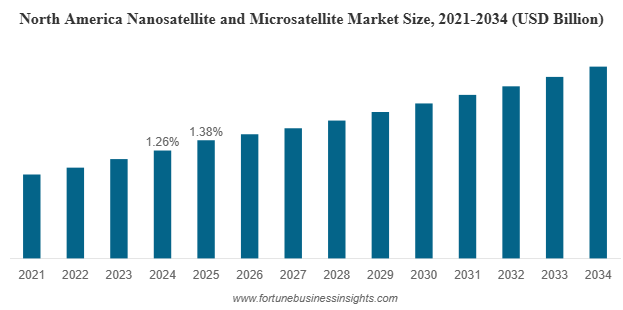
PUNE, MAHARASHTRA, INDIA, February 8, 2026 /EINPresswire.com/ -- The global Nanosatellite and Microsatellite Market—critical for space communication, Earth observation, scientific research, navigation, and defense applications—is projected to grow significantly over the coming decade. According to Fortune Business Insights, the market was valued at approximately USD 3.22 billion in 2025 and is expected to reach USD 5.23 billion by 2034, exhibiting a compound annual growth rate (CAGR) of about 5.6% during 2026–2034. — Fortune Business Insights
Nanosatellites (1–10 kg) and microsatellites (10–100 kg) are smaller, cost-effective alternatives to traditional satellites, enabling faster deployment, reduced launch costs, and versatile operation across commercial, civil, and defense sectors.
Request a Sample PDF: https://www.fortunebusinessinsights.com/enquiry/request-sample-pdf/microsatellite-and-nanosatellite-market-104860
Market Dynamics and Growth Drivers
The nanosatellite and microsatellite market is being shaped by several key trends and drivers:
• Rapid Deployment Across Diverse Sectors: Increasing demand for satellite technologies for communication, remote sensing, navigation, and scientific observation is driving market expansion.
• Adoption in Commercial Constellations: The rollout of small satellite constellations for broadband connectivity, IoT, and data services is fueling demand for nanosatellite and microsatellite platforms.
• Technological Miniaturization: Advances in miniaturized components and systems enhance satellite capabilities while keeping costs low, encouraging broader adoption across industries.
• Defense and Government Programs: Growing defense space spending and national space initiatives increase the deployment of small satellites for surveillance, reconnaissance, and secure communication.
These factors collectively reinforce the importance of small satellite systems as flexible, cost-efficient space assets across public and private sectors.
________________________________________
Market Segmentation Analysis
The nanosatellite and microsatellite market is segmented based on type, component, application, orbit, and end use:
1. By Type:
• Nanosatellites (1 to 10 kg): Compact and cost-efficient satellites often used for IoT, communication, and experimental missions.
• Microsatellites (10 to 100 kg): Larger platforms capable of hosting advanced payloads for imaging, Earth observation, and high-bandwidth communications.
2. By Component:
• Payload: Imaging systems, RF sensors, scientific instruments.
• Telemetry, Tracking & Command (TT&C): Essential for satellite operations.
• Power Systems: Solar arrays and batteries.
• Propulsion Systems, Command & Data Handling, Others.
3. By Application:
• Communication: Expanding use in broadband and IoT services.
• Earth Observation & Remote Sensing: Environmental monitoring and mapping services.
• Scientific Research & Exploration: Space science missions.
• Defense, Security & Intelligence: ISR and tactical communications.
• Navigation, Positioning & Timing: Satellite navigation services.
4. By Orbit:
• Low Earth Orbit (LEO): Dominant due to lower launch costs and wide applicability.
• Medium Earth Orbit (MEO), Highly Elliptical Orbit (HEO).
5. By End Use:
• Civil: Government and public sector programs.
• Military: Defense space missions.
• Commercial: Satellite service providers and private sector applications.
________________________________________
Regional Market Performance
Regional adoption varies based on space exploration programs, satellite deployment strategies, and national investments in space technology:
• North America: Led the market in 2025, driven by strong space industry infrastructure, significant defense contracts, and commercial constellation projects.
• Europe: Growth supported by expanding defense space budgets and small satellite missions for environmental and secure communication purposes.
• Asia Pacific: Rising government investments in satellite technology for national security, scientific research, and connectivity.
• Latin America & Middle East & Africa: Emerging growth from affordable Earth observation solutions and collaborative satellite deployment initiatives.
________________________________________
Competitive Landscape and Key Players
The market features established small satellite manufacturers and space technology innovators, including:
• GOMspace Group A/S
• NanoAvionics
• Axelspace Corporation
• AAC Clyde Space AB
• Surrey Satellite Technology Ltd.
• Terran Orbital Corporation
• Sierra Nevada Corporation
• Spire Global, Inc.
• Planet Labs
These companies compete on technology innovation, production scale, and constellation contracts to meet the growing demand for small satellite solutions.
________________________________________
Market Challenges and Opportunities
Challenges:
• Orbital Congestion & Regulations: Increasing satellite deployments contribute to space debris and regulatory complexity, affecting operations and launch timelines.
• Satellite Durability: Smaller satellites face limitations in lifespan and resilience to harsh space conditions.
Opportunities:
• Defense Adoption: Rising defense budgets and strategic ISR missions are driving demand for small satellite deployments.
• Commercial Constellations: Growth in commercial broadband, IoT, and data service constellations continues to open new avenues for small satellite applications.
Press for an Enquiry:
https://www.fortunebusinessinsights.com/enquiry/speak-to-analyst/microsatellite-and-nanosatellite-market-104860
________________________________________
Market Outlook and Future Trends
Looking toward 2034, the nanosatellite and microsatellite market is expected to sustain steady growth as demand for cost-efficient space infrastructure increases across communication, observation, scientific, and defense applications. Innovation in miniaturized technologies, integrated payload systems, and constellation-ready satellite architectures will further expand the market’s capabilities in new and existing application domains.
Ashwin Arora
Fortune Business Insights™ Pvt. Ltd.
+1 833-909-2966
sales@fortunebusinessinsights.com
Legal Disclaimer:
EIN Presswire provides this news content "as is" without warranty of any kind. We do not accept any responsibility or liability for the accuracy, content, images, videos, licenses, completeness, legality, or reliability of the information contained in this article. If you have any complaints or copyright issues related to this article, kindly contact the author above.
