

Anti-Static Carbon Core Filament Yarns Market Forecast 2026–2036: Market to Reach USD 1.3 Billion by 2036 at 7.5% CAGR
Anti-Static Carbon Core Filament Yarns Market to Grow with Rising Demand in Electronics, Textiles & Industrial Applications
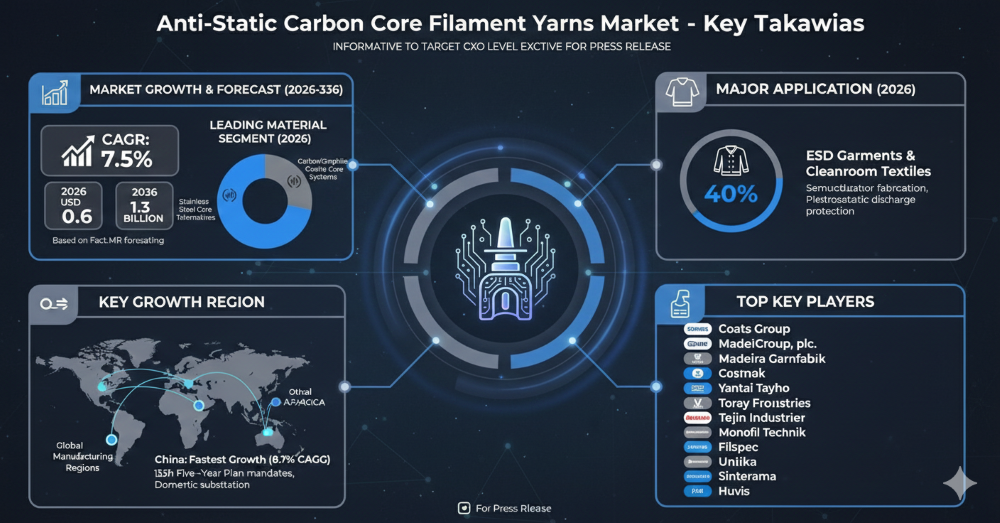
ROCKVILLE, MD, UNITED STATES, February 25, 2026 /EINPresswire.com/ -- The global anti-static carbon core filament yarns market is projected to grow from a value of US$ 0.6 billion in 2026 to US$ 1.3 billion by the end of 2036. This steady expansion, driven by a compound annual growth rate (CAGR) of 7.5%, reflects the increasing necessity for advanced electrostatic discharge (ESD) protection across critical industrial sectors.Request for Sample Report | Customize Report | Purchase Full Report - https://www.factmr.com/connectus/sample?flag=S&rep_id=14205
Market snapshot: global Anti-Static Carbon Core Filament Yarns Market Demand 2026 - 2036
Market size 2026:The market is valued at US$ 0.6 billion.
Market size 2036:The market is projected to reach US$ 1.3 billion.
CAGR:The market will expand at a steady CAGR of 5.7% from 2026 to 2036.
Leading product segment(s):Polyester-based yarns hold a dominant 45.1% share, while nylon-based variants account for 25.6% of the market.
Leading material type:Synthetic fibers lead the market with a 58.1% share.
Leading end use:The industrial sector is the primary consumer, commanding a 51.9% market share.
Key growth regions:North America and East Asia are identified as the primary regions driving demand.
Top companies:Key players include Toray Industries, Inc., Teijin Limited, Kuraray Co., Ltd., Barnet, Swicofil AG, and KB Seiren, Ltd.
Market Momentum (YoY Path)
The anti-static carbon core filament yarns market is on a consistent upward trajectory. Starting at US$ 692.2 million in 2026, the valuation is expected to climb to US$ 774.2 million by 2028. Continued industrial integration will see the market reach US$ 865.8 million in 2030 and US$ 915.2 million by 2031. Growth persists through the next decade, hitting US$ 1,023.7 million in 2033, eventually culminating in a total market size of US$ 1,202.6 million by 2036.
Why the Market is Growing
The primary catalyst for market expansion is the rising demand for safety and reliability in electronics manufacturing and hazardous environments. As electronic components become smaller and more sensitive, the need for textiles that prevent static buildup becomes mandatory. Additionally, the expansion of the automotive and healthcare sectors, where static-free environments are critical for sensitive equipment, further bolsters market demand.
Segment Spotlight
Product Type:Polyester-based yarns lead the category with a 45.1% share. These yarns are preferred for their durability and cost-effectiveness in creating conductive pathways that safely dissipate static charges in industrial workwear.
Material Type:Synthetic fibers dominate with 58.1% of the market. The high adoption is attributed to their superior strength and the ease with which carbon cores can be integrated into synthetic structures to ensure long-lasting anti-static properties.
End Use:The Industrial sector captures 51.9% of the market. This dominance is driven by the rigorous safety standards in oil and gas, chemical processing, and electronics assembly, where anti-static clothing is essential for worker safety and product integrity.
Drivers, Opportunities, Trends, Challenges
Drivers: The rapid evolution of the electronics industry and the global push for workplace safety regulations are the main engines of growth. The requirement for ESD-safe cleanroom garments is higher than ever.
Opportunities: There is significant potential in the development of "smart textiles." Integrating anti-static yarns into wearable technology and advanced medical garments opens new revenue streams for manufacturers.
Trends: A major trend is the shift toward hybrid yarns that combine anti-static properties with flame resistance. Manufacturers are increasingly focusing on yarns that offer multi-hazard protection in a single textile.
Challenges: High production costs associated with the precision engineering of carbon-core filaments remain a hurdle. Additionally, fluctuations in the prices of raw synthetic polymers can impact the profit margins of market participants.
Country Growth Outlook (CAGR)
The growth outlook for the market varies by country, with India leading the expansion at a 7.1% CAGR, followed closely by China at 6.4%. In the Americas, Brazil and the USA are projected to grow at 5.5% and 5.2% respectively, while European nations show steady progress with Germany at 4.9%, the UK at 4.7%, and France at 4.5%.
Competitive Landscape
The market is characterized by technical expertise and specialized manufacturing capabilities. Key industry participants include Toray Industries, Inc., Teijin Limited, Kuraray Co., Ltd., Barnet, Swicofil AG, and KB Seiren, Ltd. These companies focus on R&D to enhance the conductivity and wash-fastness of their filament yarns.
To View Related Report:
Cyclopentane Market https://www.factmr.com/report/371/cyclopentane-market
Microfiber Synthetic Leather Market https://www.factmr.com/report/398/microfiber-synthetic-leather-market
Landfill Gas Market https://www.factmr.com/report/429/landfill-gas-market
Automotive Lubricant Market https://www.factmr.com/report/434/automotive-lubricant-market
About Fact.MR
Fact.MR is a global market research and consulting firm, trusted by Fortune 500 companies and emerging businesses for reliable insights and strategic intelligence. With a presence across the U.S., UK, India, and Dubai, we deliver data-driven research and tailored consulting solutions across 30+ industries and 1,000+ markets. Backed by deep expertise and advanced analytics, Fact.MR helps organizations uncover opportunities, reduce risks, and make informed decisions for sustainable growth.
S. N. Jha
Fact.MR
+ +1 628-251-1583
sales@factmr.com
Legal Disclaimer:
EIN Presswire provides this news content "as is" without warranty of any kind. We do not accept any responsibility or liability for the accuracy, content, images, videos, licenses, completeness, legality, or reliability of the information contained in this article. If you have any complaints or copyright issues related to this article, kindly contact the author above.
