

AI in Logistics Market to Reach US$306.76 Billion by 2032, led by North America
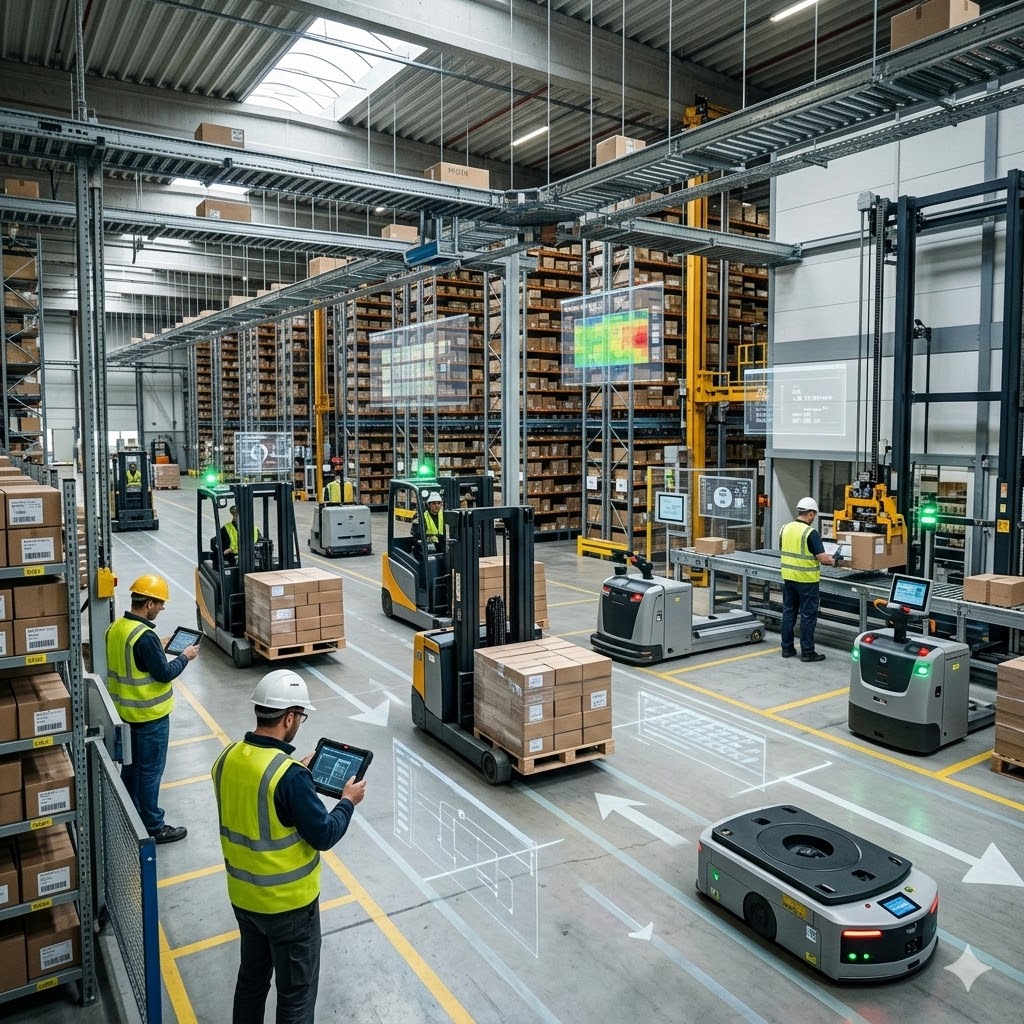
Rapid AI adoption in logistics is transforming supply chains through automation, predictive analytics, route optimization, and warehouse intelligence worldwide.
AI is redefining logistics efficiency by minimizing costs, improving delivery accuracy, and enabling real-time decision-making. Companies investing early in AI-driven automation.”
AUSTIN, TX, UNITED STATES, February 27, 2026 /EINPresswire.com/ -- Leander Texas -— DataM Intelligence
AI in logistics market reached US$15.28 billion in 2024 and is expected to reach US$306.76 billion by 2032, growing with a CAGR of 42% from 2025-2032.
The AI in logistics market’s rapid growth is propelled by strong adoption in the U.S. and Japan, driven by strategic AI partnerships and innovations such as PlusAI teaming with T2 to boost Level-4 autonomous trucks in Japan and U.S. firms expanding AI-powered automation systems to streamline freight, routing, and supply chain operations, enhancing efficiency and competitiveness.
Download your exclusive sample report today: (corporate email gets priority access):https://www.datamintelligence.com/download-sample/ai-in-logistics-market
Key Industry Development
United States: Key Industry Developments
✅ October 2025: C.H. Robinson scaled its fleet of generative AI agents past 30, automating over 3 million shipping tasks including price quotes, order processing, and load tracking to enhance supply chain efficiency and speed.
✅ June 2025: Uber Freight launched an industry-first AI logistics network powered by a logistics-specific LLM, featuring over 30 AI agents for real-time optimization, execution across the freight lifecycle, and proactive disruption management.
✅ May 2025: C.H. Robinson expanded its AI agents across the shipment lifecycle, building on 2023 launches to automate complex tasks from emails to LTL orders, reducing processing time to under 90 seconds for over 5,200 customers.
Japan: Key Industry Developments
✅ September 2025: Damon unveiled full-scenario AI-powered logistics and warehouse automation solutions at Logis-Tech Tokyo 2025, featuring an AI "brain" for narrow-aisle navigation, irregular-package handling, and multi-category sorting to drive unmanned innovation.
✅ September 2025: The Japan AI-driven logistics and delivery market reached USD 1,708.45 million, fueled by government infrastructure initiatives, e-commerce growth, and AI-robotics integration addressing labor shortages through predictive analytics and autonomous systems.
✅ December 2025: Rakuten advanced its agentic AI platform with expansions in autonomous delivery, adding Avride robots to Rakuten and Cartken fleets in Tokyo, alongside Japanese-optimized LLMs to boost logistics efficiency across its ecosystem.
Steategic M&A-
✅ Uber Technologies, Inc. → Transplace (January 2025)
In January 2025, Uber Technologies announced the acquisition of Transplace’s AI-driven freight optimization assets to strengthen its end-to-end digital freight and supply chain orchestration capabilities. The transaction, valued at approximately US$ 950 million, enhances Uber Freight’s machine learning–based route planning, predictive analytics, and real-time shipment visibility solutions, reinforcing its AI logistics footprint across North America.
✅ SAP SE → project44 (March 2025)
In March 2025, SAP SE completed the acquisition of project44 in a deal reported at nearly US$ 2.1 billion. The strategic move integrates advanced AI-powered shipment tracking, predictive ETA modeling, and automated exception management into SAP’s digital supply chain portfolio, enabling enhanced real-time logistics intelligence for global enterprise customers.
✅ Manhattan Associates, Inc. → Locus Robotics (June 2025)
In June 2025, Manhattan Associates acquired Locus Robotics for an undisclosed amount to expand its AI-enabled warehouse automation capabilities. The acquisition strengthens robotics-driven fulfillment operations, combining AI-based inventory optimization, autonomous mobile robots, and intelligent warehouse execution systems to address rising e-commerce logistics demand.
✅ Descartes Systems Group → Shippeo (September 2025)
In September 2025, Descartes Systems Group acquired Shippeo for approximately US$ 230 million. The transaction enhances Descartes’ AI-powered multimodal transportation visibility solutions, incorporating predictive analytics, machine learning algorithms, and automated freight performance monitoring to improve global logistics transparency and operational efficiency.
Major Players:-
NVIDIA | Amazon Web Services, Inc. | UPS | DHL | Microsoft Corporation | Infosys | IBM Corporation | Intel Corporation | FedEx Corporation | SAP SE
NVIDIA – With a 15.9% share, NVIDIA leads the AI in logistics market by providing high-performance GPUs and AI accelerators for real-time analytics, autonomous robotics, and predictive systems that power logistics AI applications and optimization tools. Its hardware is essential for processing large logistics datasets.
Amazon Web Services, Inc. – Holding 14.2% market share, AWS dominates with scalable cloud infrastructure and AI services used for fleet management, warehouse automation, and predictive logistics intelligence. Its broad cloud ecosystem enables rapid AI deployment across global logistics operations.
United Parcel Service – UPS commands 12.4% share, driven by advanced AI-enabled route optimization, autonomous delivery systems, and digital logistics platforms. Its extensive network leverages AI to boost delivery efficiency and reduce operational costs.
DHL – With 11.7% share, DHL uses AI for automated warehousing, robotics, and intelligent supply-chain planning. Its global logistics footprint and investments in AI tech improve throughput, real-time tracking, and cross-border visibility.
Microsoft Corporation – Microsoft holds 10.6% of the market, leveraging its Azure cloud and AI-driven supply-chain suites for predictive analytics, automation, and enterprise logistics integration. Its strong enterprise partnerships accelerate AI adoption in logistics systems.
"Secure your 30% discount - get this report before the offer expires."
:https://www.datamintelligence.com/buy-now-page?report=ai-in-logistics-market (Purchase 2 or more Repots and get 50% Discount)
Market Segmenatation-
1. Segmentation by Technology:
In the United States, AI logistics technology is dominated by machine learning, computer vision, and predictive analytics that power route optimization, demand forecasting, and autonomous warehouse operations. The AI in logistics market in the US alone was valued at around USD 6.03 billion in 2024 and is forecast to reach approximately USD 242.43 billion by 2034, driven heavily by advanced analytics and robotics segments within technology deployment. In Japan, while specific AI technology segment figures are less widely reported, logistics automation growth including AI-driven warehouse management systems and autonomous guided vehicles is accelerating as companies cope with labor shortages and aging demographics, boosting adoption of intelligent robotics and analytics solutions in automation workflows.
2. Segmentation by Application:
In the US, AI applications are widely used in fleet management, demand forecasting, inventory & warehouse management, and last-mile delivery optimization as companies invest to cut costs and increase delivery speed in e-commerce logistics. Generative AI, a newer application category, is also growing; the US generative AI in logistics market was valued at about USD 349.23 million in 2024 and is expected to expand sharply by 2032 as firms use it for real-time decision-making and customer communications. In Japan, AI applications focus strongly on warehouse and automation systems to address workforce constraints, with AI-enabled systems optimizing storage, picking, and sorting to improve throughput and accuracy in highly space-constrained facilities.
3. Segmentation by Deployment Type:
US logistics providers tend to prefer cloud-based AI solutions because they easily scale for sprawling distribution networks and support real-time analytics, predictive routing, and demand prediction across borders. This trend reflects North America’s technological infrastructure and investment climate that favor SaaS and edge-AI solutions. In Japan, while both cloud and on-premise deployments are present, there is increasing uptake of hybrid models where sensitive operational data is processed locally (on-premise or edge) but analytics and optimization are supported via cloud APIs due to data security priorities in Japanese enterprises.
4. Segmentation by End-Use Industry:
In the US, retail & e-commerce and manufacturing logistics are the largest end-use industries for AI logistics solutions because of high volume delivery demands and complex multimodal supply chains, with companies like FedEx, UPS and Amazon extensively implementing AI for tracking, routing, and warehouse automation. In Japan, sectors such as automotive, electronics manufacturing, and food distribution are significant adopters of AI logistics as these industries require precision timing and traceability in supply chains, pushing investments in robotics and predictive systems to manage smaller workforce pools and tight delivery windows.
Market Drivers:-
• Accelerated Adoption of AI-Powered Supply Chain Platforms: In the U.S., companies such as Amazon and UPS are investing heavily in AI-driven route optimization and predictive demand forecasting to reduce fuel consumption and last-mile delivery time. In Japan, Yamato Transport integrates AI for parcel volume prediction and automated sorting, improving delivery precision amid rising e-commerce volumes.
• Expansion of Smart Warehousing and Robotics Deployment: U.S. logistics hubs are increasingly implementing AI-enabled robotics from firms like IBM and warehouse automation providers to enhance picking accuracy and reduce labor dependency. In Japan, companies such as Daifuku Co., Ltd. deploy AI-integrated automated storage and retrieval systems (AS/RS), addressing space constraints and boosting operational efficiency.
• Rising Labor Shortages and Aging Workforce: The U.S. trucking industry faces persistent driver shortages, prompting AI-based fleet management and autonomous vehicle trials backed by NVIDIA. In Japan, demographic decline and an aging workforce accelerate adoption of AI-driven logistics automation and delivery robots to sustain service levels and reduce operational disruptions.
• Government-Led Digital Transformation Initiatives: The U.S. Department of Transportation promotes AI integration in freight optimization and smart infrastructure programs, encouraging private-sector innovation. Japan’s “Society 5.0” strategy supports AI-enabled logistics modernization, fostering public-private collaboration and digital freight platforms to enhance national supply chain resilience.
• Growth of Cross-Border Trade and Real-Time Visibility Demand: Increasing U.S.–Asia trade volumes require AI-based real-time shipment tracking and predictive analytics to mitigate port congestion risks. Japanese logistics providers leverage AI-powered analytics platforms to improve customs clearance forecasting, optimize maritime logistics, and enhance transparency across global supply chain networks.
Regional insights:-
1️⃣ North America: 41% (Largest share - driven by early adoption of AI tech, advanced logistics automation, and strong US investment).
• Most reports indicate North America as the dominant region with 40%+ share in the AI in logistics market.
• Precedence Research estimated 42% share in 2024.
(Includes US as primary driver; strong penetration of AI solutions for route optimization, warehouse automation, predictive analytics, etc.)
2️⃣ Asia Pacific: 26.7% (Fastest-growing region - driven by e-commerce expansion, smart logistics investment, and digital transformation in China, Japan, India).
• VerifiedMarketReports notes 35% share for AI in logistics & supply chain.
• Cognitiv Market Research reports Asia Pacific at 26.75% share by 2025 (China, Japan, India being key contributors).
(Japan contributes a portion of APAC’s share - Japan’s AI supply chain applications were 4.0% of global supply chain AI as of 2023 per Grand View Research, though this is not a logistics-only figure).
3️⃣ Europe: 27% (Significant share, backed by strong logistics networks and sustainability/AI programs).
• VerifiedMarketReports cites Europe at 15% share in AI logistics.
• Other reports ( Cognitiv) show 27% regional share in 2025.
Get Customization in the report as per your requirements:https://www.datamintelligence.com/customize/ai-in-logistics-market
Sai Kumar
DataM Intelligence 4market Research LLP
+1 877-441-4866
email us here
Visit us on social media:
LinkedIn
X
Legal Disclaimer:
EIN Presswire provides this news content "as is" without warranty of any kind. We do not accept any responsibility or liability for the accuracy, content, images, videos, licenses, completeness, legality, or reliability of the information contained in this article. If you have any complaints or copyright issues related to this article, kindly contact the author above.
