

Bipolar Disorder Treatment Market is expected to reach US$ 9.75 billion by 2033 | DataM Intelligence
Bipolar Disorder Treatment Market
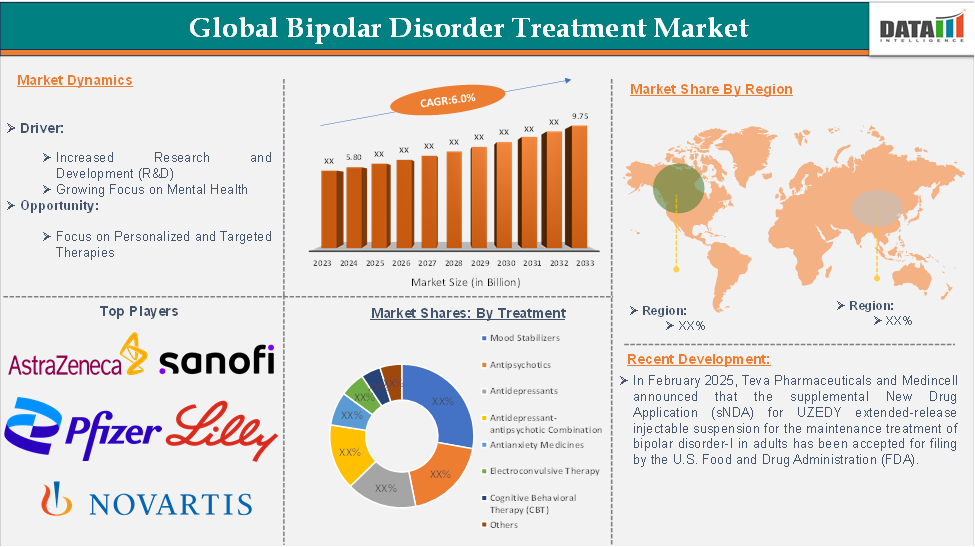
The Global Bipolar Disorder Treatment Market is expected to reach at a CAGR of 6.0% during the forecast period 2025-2033.
The Bipolar Disorder Treatment Market is expanding rapidly, driven by rising mental health awareness, innovative therapies, and increasing demand for personalized psychiatric care solutions.”
AUSTIN, TX, UNITED STATES, February 27, 2026 /EINPresswire.com/ -- Market Overview:— DataM Intelligence
The Bipolar Disorder Treatment Market has emerged as a critical segment within the global mental healthcare industry, driven by increasing awareness of psychiatric disorders, rising diagnosis rates, and expanding access to advanced therapeutic interventions. Bipolar disorder, characterized by alternating episodes of mania and depression, requires long-term clinical management involving pharmacological therapies, psychotherapy, and supportive care systems. Growing recognition of mental health as a public health priority, combined with improvements in diagnostic technologies and treatment personalization, is significantly influencing market expansion worldwide.
To Download Sample Report Here: https://www.datamintelligence.com/download-sample/bipolar-disorder-treatment-market
According to DataM Intelligence, The Global Bipolar Disorder Treatment Market was valued at approximately USD 5.80 billion in 2024 and is projected to reach nearly USD 9.75 billion by 2033, growing at a CAGR of 6.0% during the forecast period (2025-2033). The rising prevalence of mood disorders, increasing healthcare spending, and strong investments in neuropsychiatric drug development are major growth drivers. The pharmacological treatment segment, particularly mood stabilizers and atypical antipsychotics, dominates the market due to their clinical effectiveness in relapse prevention. Geographically, North America leads the market owing to advanced healthcare infrastructure, high mental health awareness, favorable reimbursement systems, and the presence of major pharmaceutical innovators.
Key Highlights from the Report:
Increasing global prevalence of bipolar disorder is accelerating demand for long-term treatment solutions.
Mood stabilizers and antipsychotic medications account for the largest revenue share in treatment adoption.
Growing investments in psychiatric drug innovation are strengthening market competitiveness.
Digital mental health platforms are improving patient monitoring and therapy adherence.
North America remains the dominant regional market due to strong healthcare access and diagnosis rates.
Emerging economies are witnessing rapid growth supported by mental health awareness initiatives.
Market Segmentation:
The Bipolar Disorder Treatment Market is segmented based on treatment type, disorder type, distribution channel, and end-user settings. Treatment type segmentation primarily includes medications, psychotherapy, and combination therapies. Among these, medication-based treatment remains the cornerstone of bipolar disorder management. Mood stabilizers such as lithium compounds, anticonvulsants, and second-generation antipsychotics are widely prescribed to control manic and depressive episodes. Combination therapy involving pharmacological treatment and cognitive behavioral therapy is gaining traction due to improved long-term patient outcomes.
Based on disorder type, the market is categorized into Bipolar I Disorder, Bipolar II Disorder, and Cyclothymic Disorder. Bipolar I Disorder accounts for the largest market share as it often requires intensive clinical intervention and prolonged treatment duration. Increasing diagnosis of Bipolar II Disorder, particularly among young adults, is also contributing to expanding treatment demand.
In terms of distribution channels, hospital pharmacies dominate due to prescription-based medication requirements and supervised treatment administration. However, retail pharmacies and online pharmacy platforms are witnessing rapid growth, supported by telepsychiatry adoption and digital prescription services.
End-user segmentation includes hospitals, psychiatric clinics, specialty mental health centers, and homecare settings. Hospitals and specialty psychiatric institutions remain primary treatment hubs, while community-based mental health services are expanding rapidly to support outpatient care and relapse prevention programs.
Speak to Our Analyst and Get Customization in the report as per your requirements: https://www.datamintelligence.com/customize/bipolar-disorder-treatment-market
Regional Insights:
North America holds the largest share in the Bipolar Disorder Treatment Market due to well-established mental healthcare systems and strong government initiatives supporting psychiatric care. The United States leads regional growth with high diagnosis rates, increased insurance coverage for behavioral health services, and continuous clinical research activities focused on mood disorder therapies.
Europe represents the second-largest market, supported by national mental health programs, increasing public awareness campaigns, and improved access to psychiatric counseling services. Countries such as Germany, the United Kingdom, and France are actively investing in mental health integration within primary healthcare systems.
The Asia-Pacific region is expected to witness the fastest growth during the forecast period. Rising urban stress levels, expanding healthcare infrastructure, and increasing awareness surrounding mental illnesses are contributing to higher treatment adoption across countries like China, India, Japan, and South Korea. Government initiatives aimed at reducing social stigma associated with psychiatric disorders are further strengthening regional market expansion.
Latin America and the Middle East & Africa are gradually emerging markets, driven by improving healthcare accessibility and growing recognition of mental health disorders as a significant societal concern.
Market Dynamics:
Market Drivers
One of the primary drivers of the Bipolar Disorder Treatment Market is the increasing global burden of mental health disorders. Lifestyle stress, genetic predisposition, substance abuse, and socio-economic pressures have contributed to a rise in bipolar disorder diagnoses worldwide. Additionally, advancements in neurobiology research have improved understanding of mood regulation mechanisms, enabling the development of targeted therapies. Growing acceptance of mental health treatment and expanding insurance reimbursement policies are also encouraging patients to seek professional care earlier, thereby boosting treatment demand.
Market Restraints
Despite significant growth potential, several challenges hinder market expansion. High treatment costs, long therapy duration, and medication-related side effects remain major concerns for patients and healthcare providers. Limited access to trained psychiatric professionals in low- and middle-income countries restricts timely diagnosis and treatment initiation. Furthermore, social stigma associated with mental illness continues to discourage individuals from seeking treatment, particularly in developing regions.
Market Opportunities
The market presents strong opportunities through innovation in precision psychiatry and digital therapeutics. Integration of artificial intelligence in mental health monitoring, wearable mood-tracking technologies, and telepsychiatry platforms is transforming patient management. Pharmaceutical companies are increasingly investing in novel drug formulations with improved safety profiles and reduced relapse risks. Expansion of community-based mental health programs and increasing collaborations between healthcare providers and technology firms are expected to unlock new growth avenues in the coming years.
Looking For Full Report? Get it Here: https://www.datamintelligence.com/buy-now-page?report=bipolar-disorder-treatment-market
Frequently Asked Questions (FAQs):
How Big is the Bipolar Disorder Treatment Market globally?
What is the projected growth rate of the Bipolar Disorder Treatment Market through 2033?
Who are the key players operating in the global Bipolar Disorder Treatment Market?
What factors are driving growth in the Bipolar Disorder Treatment Market?
Which region is expected to dominate the Bipolar Disorder Treatment Market during the forecast period?
Company Insights:
Key companies operating in the Bipolar Disorder Treatment Market include:
AstraZeneca
AbbVie Inc.
Otsuka Pharmaceutical Co., Ltd.
Eli Lilly and Company
Intra‑Cellular Therapies, Inc. (Johnson & Johnson Services, Inc.)
Sanofi
Sun Pharmaceutical Industries Ltd.
GSK plc
Novartis AG
Pfizer Inc.
Recent Developments:
United States:
February 2026: The National Institute of Mental Health funded research into neuromodulation devices like transcranial magnetic stimulation for treatment-resistant bipolar depression. Pilot studies reported 40% symptom reduction. This innovation supports the steady 2.4% market CAGR amid heightened mental health awareness.
January 2026: Healthcare providers expanded telepsychiatry programs for bipolar management, integrating AI-driven mood tracking apps reimbursed under new Medicare guidelines. Adoption surged due to improved access in rural areas. These digital tools complement pharmacotherapy in the growing USD 1.8 billion projected market.
December 2025: A major pharmaceutical firm launched a Phase III trial for a dual-action mood stabilizer targeting rapid cycling bipolar disorder. Early data showed reduced relapse rates by 25% compared to standard lithium therapy. This reflects rising investment in precision treatments amid a market valued at USD 1.7 billion.
November 2025: The U.S. Food and Drug Administration approved a novel long-acting injectable antipsychotic for maintenance therapy in bipolar I disorder, improving patient adherence. This addresses ongoing challenges with daily oral medications. Market demand for such formulations is projected to drive segment growth at a 2.4% CAGR through 2035.
Japan:
February 2026: Expanded reimbursement for mood stabilizers and antipsychotics under revised national health insurance promoted outpatient treatment. Initiatives target stress-related disorders in urban workers. The market reflects robust growth from heightened psychiatric R&D.
January 2026: Collaborations between pharma and tech firms advanced predictive analytics for bipolar relapse prevention, validated in nationwide trials. Outcomes showed 20% fewer hospitalizations. Market growth is fueled by stringent yet supportive regulations.
December 2025: A leading biotech introduced an AI-powered digital therapeutic for real-time bipolar mood monitoring, integrated into primary care services. Regulatory endorsement accelerated its rollout for early intervention. This boosts adherence in Japan's aging population.
November 2025: Japan's Ministry of Health approved pharmacogenomic testing for personalized bipolar pharmacotherapy, reducing adverse effects in 30% of cases. This aligns with national digital health initiatives. The therapeutics market anticipates a 5.1% CAGR through 2035.
Unlock 360° Market Intelligence with DataM Subscription Services: https://www.datamintelligence.com/reports-subscription
Conclusion:
The Bipolar Disorder Treatment Market is undergoing steady transformation as mental health gains global recognition as a healthcare priority. Rising disease prevalence, expanding treatment accessibility, and continuous innovation in psychiatric therapeutics are driving sustained market growth. While challenges such as treatment affordability and social stigma persist, advancements in digital healthcare, personalized medicine, and community-based mental health initiatives are expected to reshape the future of bipolar disorder management. As healthcare systems increasingly prioritize behavioral health integration, the market is poised for consistent expansion through the forecast period, offering significant opportunities for pharmaceutical companies, healthcare providers, and technology innovators alike.
Related Reports:
Pleuropulmonary Blastoma Treatment Market
Infectious Diseases Treatment Market
Sai Kiran
DataM Intelligence 4Market Research
+1 877-441-4866
Sai.k@datamintelligence.com
Visit us on social media:
LinkedIn
X
Legal Disclaimer:
EIN Presswire provides this news content "as is" without warranty of any kind. We do not accept any responsibility or liability for the accuracy, content, images, videos, licenses, completeness, legality, or reliability of the information contained in this article. If you have any complaints or copyright issues related to this article, kindly contact the author above.
