

Global High Speed Memory Signal Integrity Test Market Led by North America as Keysight Expands Testing Solutions
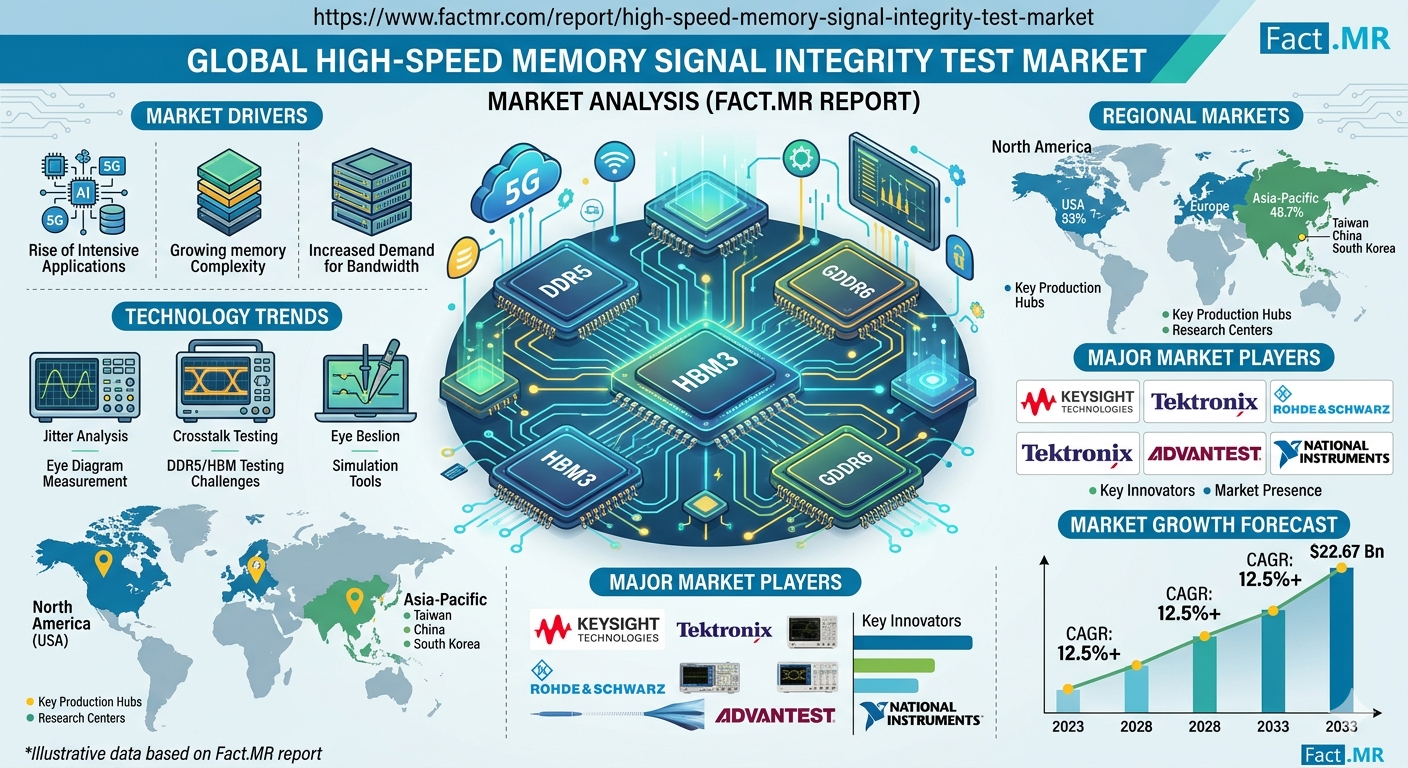
High-Speed Memory Signal Integrity Test
High-Speed Memory Signal Integrity Test Market Size and Share Forecast Outlook
ROCKVILLE, MD, UNITED STATES, April 7, 2026 /EINPresswire.com/ -- The global High-Speed Memory Signal Integrity Test market is entering a decade of transformative growth, projected to surge from USD 1.22 billion in 2026 to USD 2.23 billion by 2036. According to the latest market analysis, this represents a steady CAGR of 6.2%, fueled by the critical need for signal validation in ultra-high-frequency computing environments.As semiconductor nodes shrink and data rates soar, the industry is witnessing an absolute dollar opportunity of USD 1.01 billion over the next ten years. The market’s expansion is tethered to the rapid rollout of DDR5/DDR6, HBM3/4, and GDDR7 interfaces, where timing margins are increasingly razor-thin.
Get Access Report Sample :
https://www.factmr.com/connectus/sample?flag=S&rep_id=13216
Market Snapshot: 2026–2036
2026 Valuation: USD 1.22 Billion
2036 Projection: USD 2.23 Billion
Growth Multiple: ~1.8x
Dominant Segment: Real-Time / Sampling Oscilloscopes (34.0% Market Share)
Leading Data-Rate Band: 32-64 Gb/s (32.0% Market Share)
Key Market Dynamics & Drivers
The shift toward High-Performance Computing (HPC) and AI workloads has fundamentally changed memory requirements. Modern datacenters demand unprecedented signal quality, pushing signal integrity (SI) testing from a secondary check to a primary infrastructure requirement.
Ultra-High Frequencies: As interfaces migrate toward and beyond 112 Gb/s, detecting crosstalk, noise, and jitter becomes paramount.
Next-Gen Interface Adoption: The transition to HBM4 and DDR6 is forcing semiconductor vendors to invest in high-precision measurement systems.
Automated Validation: A rising trend in automated measurement configurations is reducing manual analysis risks and accelerating time-to-market for chipmakers.
Segmental Intelligence
By Instrument: Oscilloscopes Lead the Charge
The Real-Time and Sampling Oscilloscope segment remains the leading instrument class, capturing 34.0% of the market in 2026. These tools are indispensable for advanced waveform capture and precise signal analysis in semiconductor validation units.
By Data-Rate: The "Sweet Spot" (32-64 Gb/s)
The 32-64 Gb/s data-rate band accounts for 32.0% of the market. This segment serves as the current industry standard for high-speed memory interfaces, offering the best balance of cost-effectiveness and performance for mid-range and high-end server applications.
Regional Outlook: China and Brazil Outpace Global Average
While North America and Europe maintain strong institutional footprints, the highest growth rates are emerging from developing semiconductor hubs:
Country
Projected CAGR (2026-2036)
Growth Driver
China
7.6%
Massive expansion in domestic memory manufacturing & policy support.
Brazil
7.2%
Rising industrial investment and infrastructure modernization.
South Korea
6.3%
Concentration of Tier-1 memory giants (Samsung, SK Hynix).
USA
6.1%
Innovation in AI accelerators and hyperscale datacenter labs.
Competitive Landscape & Supply Chain
The market is characterized by a "precision-first" competition model. Leading providers are integrating software automation with hardware to provide end-to-end validation suites.
Top Market Participants:
Keysight Technologies: Dominates with integrated automation and precision measurement networks.
Rohde & Schwarz: Leading in high-frequency waveform accuracy.
Tektronix & Teledyne LeCroy: Key players in the oscilloscope and probing sectors.
Anritsu & Advantest: Critical for Bit Error Rate Testing (BERT) and ATE integration.
Supply Chain Intelligence: These providers supply directly to Semiconductor Vendors (NVIDIA, AMD, Micron), Hyperscaler Labs (AWS, Google), and System/Server OEMs (Dell, HPE).
Risks & Investment Opportunities
Investment Opportunity: High-speed probing and fixtures for >112 Gb/s applications represent the next frontier for high-margin revenue.
Trend: Development of multi-channel compatibility systems that can test multiple memory standards (e.g., LPDDR6 and GDDR7) on a single platform.
Critical Risk: The high capital expenditure (CapEx) required for 110GHz+ bandwidth equipment may limit adoption among smaller test houses, favoring consolidated, large-scale testing facilities.
Browse Full Report –
https://www.factmr.com/report/high-speed-memory-signal-integrity-test-market
To View Related Report:
Memory Market https://www.factmr.com/report/memory-market
Edge AI High-Bandwidth Memory Chips Market https://www.factmr.com/report/edge-ai-high-bandwidth-memory-chips-market
Test Paper Market https://www.factmr.com/report/3372/test-paper-market
SoC Test Platform Market https://www.factmr.com/report/soc-test-platform-market
S. N. Jha
Fact.MR
+1 628-251-1583
email us here
Legal Disclaimer:
EIN Presswire provides this news content "as is" without warranty of any kind. We do not accept any responsibility or liability for the accuracy, content, images, videos, licenses, completeness, legality, or reliability of the information contained in this article. If you have any complaints or copyright issues related to this article, kindly contact the author above.
