

Your top news on small business
Provided by AGP
Lara Translate Adds Profanity Detection Across 200+ Languages
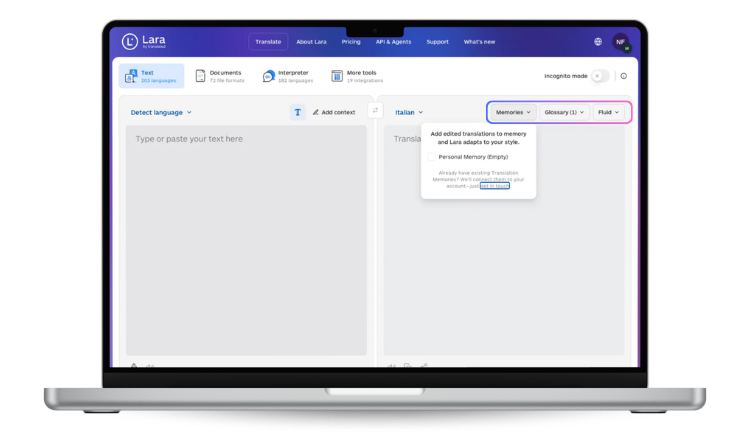
Moderation tools were built for a single language. The internet was not.
ROME, LAZIO, ITALY, May 15, 2026 /EINPresswire.com/ -- Lara Translate released Profanity Detection and Filtering, available both as a standalone feature and as an integrated option within its translation workflow, covering more than 200 languages. The release targets a problem that has quietly grown alongside the globalization of user-generated content: the linguistic surface area for offensive language is now effectively unbounded, and moderation systems built for one language do not scale.The problem with blocklists
Traditional profanity filters work by matching strings against a list. That approach is manageable in one language. Across many languages, it requires ongoing per-language linguistic maintenance, breaks at the edges of slang and cultural context, and still misses a failure mode specific to multilingual platforms: a translation system can produce profanity in the target language that was never present in the source. A phrase that passes a Spanish-language filter may be deeply offensive to Brazilian readers of the same content. No blocklist catches that reliably.
Lara Translate's detection applies the same neural model that powers its translation engine to the filtering task. It reads offensive language in context, not as a string match, across all supported languages without separate configuration per locale.
A concrete example
A travel review platform operates in 40 markets. A user submits a review in Turkish that contains regionally offensive slang. The platform's existing filter, built for English, does not catch it. When the review is automatically translated into German for other users, the translation renders a phrase that is offensive in a different way to German readers than it was in the original. Neither the source nor the output would have been caught by a standard blocklist approach.
With Lara Translate's profanity detection integrated into the translation step, the platform can flag the source before translation, intercept offensive output after it, or instruct the translation engine to find a clean rendering that preserves meaning without the offensive language. That last option applies the constraint during generation, not as a filter applied to finished text.
“Translation and content moderation have always been treated as separate problems. They are not. The same neural understanding that makes a translation contextually accurate is what makes profanity detection reliable across languages.”
Maurizio Tiberi, Senior Director, Lara Translate
What this changes for localization and platform teams
For localization engineers, it eliminates a category of manual review. Content that previously required a post-translation human check for offensive output can now be handled programmatically, with behavior configured to the use case: a children's platform blocks outright, a content moderation dashboard flags with full metadata for human review, a community forum masks automatically.
For platform teams managing multilingual UGC at scale, the practical result is consistent moderation behavior across all supported languages with no per-language setup.
Also released
The profanity filter shipped alongside seven other updates: multidirectional glossary CSV import and export in the web app without API access; a stability and quality pass on the browser extension; team-level default preferences for Lara for Google Sheets; a More Tools tab inside the app; a Lara CLI update; a Rich Text Toggle in the text editor; and voice selection with preview in Interpreter.
Full release notes: blog.laratranslate.com/lara-translate-april-2026-updates
Resources:
Profanity Detection API: developers.laratranslate.com/docs/detect-profanities
Translation API docs: developers.laratranslate.com/docs/translate-text
April 2026 Release Notes: blog.laratranslate.com/lara-translate-april-2026-updates
Developer Docs: developers.laratranslate.com/docs
About Lara Translate
Lara Translate is an AI translation platform built on more than 20 years of neural machine translation research at Translated, a global language services company. It delivers context-aware, memory-augmented translations through a developer-first API and a suite of apps and integrations. laratranslate.com
Niccolò Fransoni
Translated SRL
press@laratranslate.com
Legal Disclaimer:
EIN Presswire provides this news content "as is" without warranty of any kind. We do not accept any responsibility or liability for the accuracy, content, images, videos, licenses, completeness, legality, or reliability of the information contained in this article. If you have any complaints or copyright issues related to this article, kindly contact the author above.
