

Semiconductor Equipment Market Forecast 2026–2035, 7.80% CAGR Pushes USD 210.02B Valuation
semiconductor equipment market
Semiconductor Equipment Market Size, Share & Industry Analysis By Type of Equipment (Wafer Processing, Assembly and Packaging, Test and Measurement, Cleaning)
The semiconductor equipment market is witnessing strong growth driven by increasing chip demand, advanced fabrication technologies, and expansion of global semiconductor manufacturing capacity.”
TAIPEI, TAIPEI, TAIWAN, June 24, 2026 /EINPresswire.com/ -- The global semiconductor equipment market is entering a sustained expansion phase, driven by government-backed fab construction programs, the relentless advancement of lithography and etch deposition equipment toward sub-3 nm process nodes, and an unprecedented surge in AI and high-performance computing workloads demanding leading-edge chip fabrication tools. — Market Research Future (MRFR)
Blending extreme ultraviolet lithography systems, next-generation wafer processing equipment, advanced packaging platforms, and AI-optimized process control technologies, the market is positioned for decade-long structural growth as the global economy's dependence on semiconductors deepens across every major industry vertical.
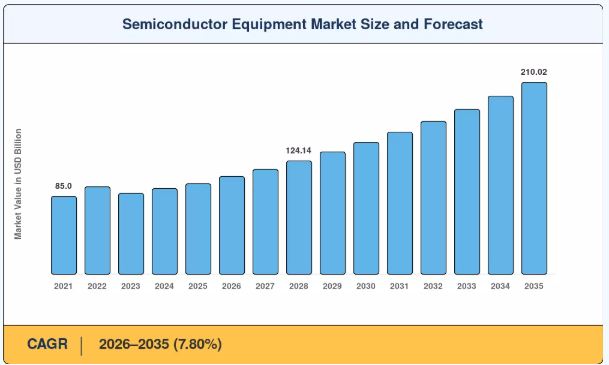
The global semiconductor equipment market reached an estimated USD 99.10 billion in 2025 and is projected to reach USD 106.83 billion in 2026, expanding to USD 210.02 billion by 2035, reflecting a CAGR of 7.80% across the 2025–2035 forecast window.
Get Full PDF Sample Copy of Report: (Including Full TOC, List of Tables & Figures, Chart) @
https://www.marketresearchfuture.com/sample_request/26067
➤ Key Drivers Fueling Market Growth
The convergence of three distinct technological and policy-driven pillars is accelerating the expansion of the semiconductor equipment market:
➤ Government Fab Subsidies and Reshoring Mandates
The U.S. CHIPS and Science Act's USD 52.7 billion allocation — including USD 39 billion in direct manufacturing incentives and the European Chips Act's EUR 43 billion mobilization target are pulling equipment procurement cycles forward by 12–18 months across multiple geographies simultaneously.
Japan's JASM consortium has secured ¥1.2 trillion in combined public-private finance for a Kumamoto fab complex, pushing wafer processing equipment delivery dates forward by two quarters. Phase-2 CHIPS Act awards targeting advanced-logic and advanced-packaging facilities are expected to require over USD 15 billion in chip fabrication tools and semiconductor lithography systems within the first 24 months of groundbreaking alone establishing a near-term demand floor that shelters the semiconductor equipment market from cyclical downturns.
➤ High-NA EUV Lithography Adoption and Node Transition Cascade
ASML's 0.55-NA EUV scanner priced above USD 350 million per unit — entered pilot production at two leading-edge foundries in 2025, with volume deployment expected to expand to five fabs by 2028. Each high-NA tool reduces multi-patterning steps but demands ancillary upgrades across mask infrastructure, pellicle systems, and etch deposition equipment stacks, creating a cascade effect that could add USD 4–6 billion in incremental semiconductor equipment market spending per year through 2030. Gate-all-around transistor architectures at 2 nm and below simultaneously demand entirely new process equipment recipes, ensuring that chip fabrication tools upgrade cycles accelerate rather than plateau as the industry approaches physical scaling limits.
➤ AI and HPC-Driven Advanced-Node Demand
AI training-cluster roadmaps now specify 2 nm and 1.4 nm process nodes for 2027–2029 tape-outs, ensuring sustained order backlogs for front-end wafer processing equipment and metrology tools across the leading semiconductor equipment suppliers. Hyperscale data center operators including Microsoft, Google, Amazon, and Meta collectively plan to invest over USD 300 billion in AI infrastructure through 2027, a significant portion of which flows directly into chip procurement at leading-edge foundries translating into equipment orders that compound through the semiconductor supply chain.
High-bandwidth memory architectures for AI accelerators are additionally driving record investment in memory-specific etch deposition equipment and advanced packaging IC manufacturing machinery across South Korean and Taiwanese fabrication clusters.
➤ Market Segmentation Analysis
To provide a granular understanding of the landscape, global market research highlights a comprehensive segmentation across several key domains:
1. By Equipment Type
Front-End Equipment: The dominant segment, expanding at an 8.81% CAGR through 2035. Encompasses semiconductor lithography systems, etch deposition equipment, chemical vapor deposition tools, and metrology platforms required for sub-3 nm wafer patterning and advanced logic node transitions.
Back-End Equipment: Captured approximately USD 28.7 billion in 2025 revenue, propelled by advanced packaging demand for chip fabrication tools. Encompasses hybrid bonders, redistribution-layer lithography systems, fan-out wafer-level packaging equipment, and thermal-compression die-attach IC manufacturing machinery a segment growing rapidly as chiplet architectures shift value pools downstream from front-end processing.
2. By Wafer Size
300mm: The largest wafer size category at 67.9% share in 2025, reflecting the economics of leading-edge logic and memory manufacturing where cost-per-die advantages scale directly with wafer diameter. Virtually all advanced AI accelerator and HBM memory chips are produced on 300mm wafer processing equipment platforms.
200mm: Experiencing a structural renaissance at a 7.38% CAGR through 2035, driven by automotive electrification creating sustained demand for silicon carbide, gallium nitride, and specialty analog device manufacturing on semiconductor lithography systems optimized for wide-bandgap substrates.
150mm and Below: Valued at USD 3.26 billion in 2025, serving specialty compound semiconductor, MEMS, and photonics applications where substrate economics and process maturity favor smaller wafer formats in defense, industrial, and telecommunications component manufacturing.
3. By Technology Generation
12nm and Below: The highest-value process node tier, demanding the most advanced semiconductor lithography systems, EUV and high-NA EUV exposure tools, and multi-step etch deposition equipment stacks for AI accelerator, server CPU, and leading-edge mobile processor manufacturing.
16nm – 22nm: An established high-volume tier serving 5G RF, networking, and automotive ADAS applications with mature deep-ultraviolet multi-patterning lithography and well-characterized etch deposition equipment processes.
32nm – 45nm: Serving mid-range microcontroller, power management IC, and embedded flash memory production, with growing refurbishment and secondary equipment market activity supporting cost-competitive specialty foundry operations.
Mature Nodes: A strategically important segment supporting automotive, industrial IoT, and analog semiconductor manufacturing where process maturity, supply chain reliability, and total cost of ownership outweigh raw node scaling as decision criteria for chip fabrication tools procurement.
4. By Application
Memory: A major demand driver for wafer processing equipment, particularly in DRAM and 3D NAND flash manufacturing transitions to HBM4 and successive stacking generations requiring precision etch deposition equipment and high-aspect-ratio patterning capability.
Logic: The primary end-application for leading-edge chip fabrication tools, encompassing AI accelerator, server CPU, mobile SoC, and FPGA manufacturing at sub-5 nm nodes across major foundry and IDM facilities.
Analog: Served by specialized mature-node semiconductor equipment configurations optimized for mixed-signal precision, power density, and long manufacturing lifecycle requirements across automotive and industrial application segments.
Discrete and RF Devices: Driving dedicated SiC and GaN wafer processing equipment investment across automotive power electronics and 5G/6G radio frequency front-end component manufacturing ecosystems.
5. By End Use
Foundries: The largest end-use category at 49.2% of the semiconductor equipment market in 2025, reflecting concentrated capital spending by contract manufacturers. TSMC, Samsung Foundry, and GlobalFoundries collectively account for the majority of leading-edge chip fabrication tools procurement globally.
Integrated Device Manufacturers (IDMs): Generated USD 30.15 billion in semiconductor equipment market revenue in 2025, driven by Intel's Intel Foundry Services capacity expansion, SK Hynix's HBM fab investment, and Infineon and ON Semiconductor's SiC wafer processing equipment buildouts.
OSATs: Logging an 8.39% CAGR as the highest-growth end-use participant category, investing in advanced packaging IC manufacturing machinery for hybrid bonding, fan-out, and chiplet integration to capture margin as heterogeneous integration architectures push value pools downstream.
Research and Development: Sustained procurement of pilot-line chip fabrication tools and semiconductor lithography systems at government and university-affiliated research institutes, driving early adoption of emerging process technologies ahead of high-volume manufacturing deployment.
Get access to the full description of the report @
https://www.marketresearchfuture.com/reports/semiconductor-equipment-market-26067
➤ Regional Insights
Asia-Pacific: Commands approximately 49.3% of semiconductor equipment market revenue and posts the fastest regional CAGR at 9.70% through 2035. Anchored by TSMC's leading-edge fab clusters in Taiwan, Samsung and SK Hynix's memory fabrication complexes in South Korea, and a rapidly expanding mainland China domestic equipment substitution program, the region represents the global center of gravity for wafer processing equipment procurement. Japan's JASM-backed Kumamoto fab expansion and India's USD 10 billion semiconductor incentive scheme are adding additional growth vectors that will extend Asia-Pacific's dominance through the forecast horizon.
North America: Holds approximately 23.8% of semiconductor equipment market revenue in 2025, sustained by the CHIPS Act-funded greenfield fab construction wave. TSMC Arizona's multi-fab campus, Intel's Ohio and Arizona expansion programs, and Samsung's Taylor, Texas facility collectively represent over USD 200 billion in announced capital investment, generating sustained multi-year procurement pipelines for chip fabrication tools and semiconductor lithography systems. The U.S. accounts for approximately 81.2% of North America's regional market share, with Canada's photonics R&D clusters and Mexico's OSAT and test operations providing complementary regional contributions.
Europe: Holds approximately 14.2% of the semiconductor equipment market, accelerating from a smaller base as the European Chips Act drives sovereign semiconductor capacity investment. Intel's Magdeburg fab program, TSMC's Dresden facility in partnership with Bosch, Infineon, and NXP, and STMicroelectronics' SiC expansion across Italy and France are anchoring a structural fab construction wave. The EU's requirement that subsidy disbursement meet environmental benchmarks is additionally stimulating energy-efficient etch deposition equipment retrofits and sustainable chip fabrication tools procurement cycles distinct from pure node-driven capex.
South America, Middle East & Africa: Emerging regions demonstrating early-stage semiconductor equipment market activity centered on back-end assembly, test facility expansion, and design center development. South America generated USD 1.38 billion in 2025 semiconductor equipment market revenue, led by Brazilian OSAT operations. Middle East and Africa are posting a 1.7% CAGR from a nascent base as Gulf state sovereign investment funds begin directing capital toward semiconductor design and early-stage packaging infrastructure programs.
➤ Top Key Companies
The global landscape is highly concentrated around a small number of critical chip fabrication tools and wafer processing equipment specialists whose technologies are irreplaceable within the semiconductor manufacturing value chain:
Applied Materials (US): The world's largest semiconductor equipment company by revenue, delivering industry-defining wafer processing equipment platforms across chemical vapor deposition, physical vapor deposition, etch, and CMP — serving every major foundry, IDM, and memory manufacturer with chip fabrication tools spanning the full front-end process sequence.
ASML (Netherlands): The sole global supplier of extreme ultraviolet lithography systems and the exclusive developer of high-NA EUV scanners, holding a monopoly position in the most critical semiconductor lithography technology that enables leading-edge logic and memory node progression at 7 nm and below.
Lam Research (US): A global leader in etch deposition equipment and surface preparation platforms, delivering the atomic-layer etch, high-aspect-ratio DRAM etch, and 3D NAND tungsten deposition tools that are foundational to memory manufacturing and advanced logic node transition programs worldwide.
Tokyo Electron (TEL, Japan): A major global specialist combining coater/developer systems, thermal processing equipment, and CVD platforms with deep application expertise across logic and memory wafer processing equipment — Japan's largest semiconductor equipment supplier by revenue.
KLA Corporation (US): The global leader in process control metrology and inspection systems, providing yield management chip fabrication tools that detect defects and overlay errors at sub-nanometer precision across every major semiconductor node transition.
Screen Holdings (Japan): A major specialist delivering wafer cleaning, thermal processing, and coating equipment across front-end semiconductor manufacturing operations, with expanding share in advanced-node cleaning platforms required for EUV photoresist processes.
Advantest (Japan): The global leader in semiconductor test equipment, providing automated test platforms for memory, SoC, and analog devices — a critical IC manufacturing machinery category whose demand scales directly with advanced-node semiconductor output volumes.
Teradyne (US): A major automated test equipment specialist combining semiconductor test systems with industrial automation platforms, serving memory, logic, and wireless semiconductor manufacturers with precision IC manufacturing machinery that validates device performance before shipment.
➤ Emerging Trends and Future Outlook
The future of the semiconductor equipment market lies in the convergence of AI-optimized fab operations, chiplet and heterogeneous integration architecture proliferation, and power semiconductor electrification supercycles. Industry leaders are building chip fabrication tools ecosystems where a foundry or IDM doesn't simply procure standalone wafer processing equipment, but continuously generates real-time process sensor data through connected tool platforms that feed factory-wide neural network optimization systems.
This data thread simultaneously allows equipment OEMs to refine process recipes remotely, deploy predictive maintenance algorithms that extend mean-time-between-failure by 30%, and develop next-generation etch deposition equipment specifications informed by real production-line constraint data rather than laboratory benchmarks alone.
As machine learning algorithms become embedded in metrology, inspection, and etch deposition equipment platforms delivering 15–20% throughput increases at advanced nodes — and as chiplet-based designs expand toward 30% of advanced-logic production by 2032, the back-end share of the semiconductor equipment market is projected to grow from roughly 25% today toward 32% by 2035.
This structural rebalancing creates new growth runways for chip fabrication tools suppliers previously confined to front-end processing, while sustainability-driven equipment retrofit mandates, Equipment-as-a-Service procurement models, and circular-economy refurbishment markets add additional revenue diversification vectors that make the semiconductor equipment market structurally resilient against cyclical demand fluctuations through the forecast horizon.
➤ FAQs
Q – How do U.S.-China export control regimes structurally impact the global semiconductor equipment market supply-demand balance and regional growth trajectories?
Ans – Export controls restricting the transfer of advanced semiconductor lithography systems, etch deposition equipment above defined throughput thresholds, and supporting subsystems to Chinese customers compress the immediate serviceable market for multiple leading semiconductor equipment OEMs while simultaneously accelerating China's domestic equipment substitution investment programs.
Q – What investment criteria should foundries and IDMs prioritize when evaluating next-generation wafer processing equipment for sub-3 nm node transitions?
Ans – Foundries and IDMs must evaluate atomic-layer process precision and repeatability across thousands of consecutive wafer cycles as the primary performance benchmark, alongside tool-to-tool matching consistency for multi-chamber etch deposition equipment configurations deployed across parallel production lines.
➤➤➤ Discover More Insights with Market Research Future:
Business Loans Market-
https://www.marketresearchfuture.com/reports/business-loans-market-23967
Commercial Insurance Market-
https://www.marketresearchfuture.com/reports/commercial-insurance-market-23980
Cbdcs And Stable Coins Market-
https://www.marketresearchfuture.com/reports/cbdcs-and-stable-coins-market-24007
Insurance Bpo Services Industry Market-
https://www.marketresearchfuture.com/reports/insurance-bpo-services-industry-market-24181
Auditing Services Market-
https://www.marketresearchfuture.com/reports/auditing-services-market-24335
Rugged Tablet Market-
https://www.marketresearchfuture.com/reports/rugged-tablet-market-24336
Wealthtech Solutions Market-
https://www.marketresearchfuture.com/reports/wealthtech-solutions-market-24442
Leasing Market-
https://www.marketresearchfuture.com/reports/leasing-market-24472
Gold Loan Market-
https://www.marketresearchfuture.com/reports/gold-loan-market-24606
Working Capital Loan Market-
https://www.marketresearchfuture.com/reports/working-capital-loan-market-24679
Sagar Kadam
Market Research Future
+ +1 628-258-0071
email us here
Legal Disclaimer:
EIN Presswire provides this news content "as is" without warranty of any kind. We do not accept any responsibility or liability for the accuracy, content, images, videos, licenses, completeness, legality, or reliability of the information contained in this article. If you have any complaints or copyright issues related to this article, kindly contact the author above.
