

New Report Finds Chicagoland's Small Business Ecosystem Has Grown Stronger, Identifies Growth Priorities and Gaps
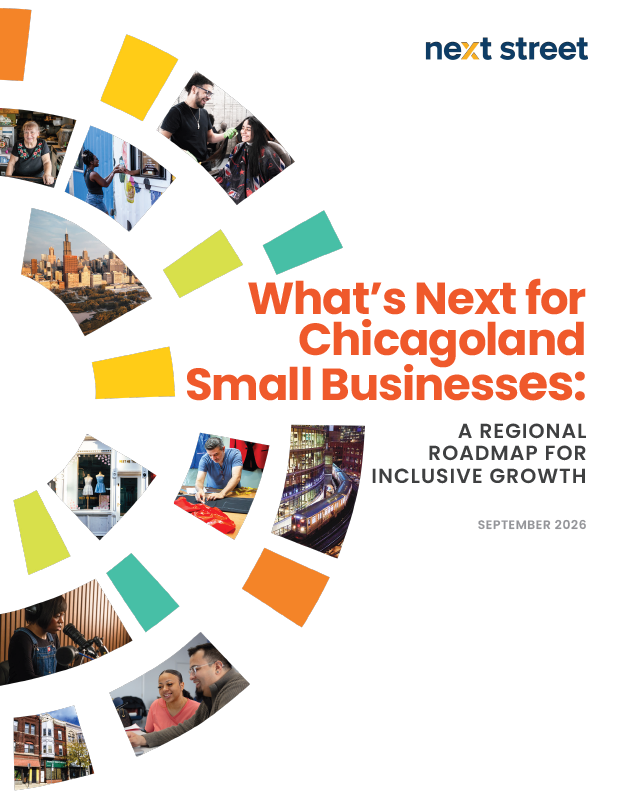
Report cover
Next Street report, supported by the Fund for Equitable Business Growth, identifies ways to build on progress by expanding capital access, growth, and more.
CHICAGO, NY, UNITED STATES, September 29, 2026 /EINPresswire.com/ -- Chicagoland has made significant progress in strengthening the resources and support available to small businesses over the past eight years, but too few businesses are translating that support into sustained growth, according to a new report from Next Street.
Released today, What’s Next for Chicagoland Small Businesses: A Regional Roadmap for Inclusive Growth revisits the region’s small business ecosystem for the first time since Next Street conducted its initial assessment in 2018. The report was commissioned by the funders of Fund for Equitable Business Growth (FEBG), including Builders Vision, The Chicago Community Trust, the Coleman Foundation, Crown Family Philanthropies, JPMorganChase, the John D. and Catherine T. MacArthur Foundation, and the Polk Bros. Foundation. In addition, a steering committee of corporate and public-sector partners, including the City of Chicago, Cook County, and Comcast Corporation, supported the report.
Chicagoland (in the report includes the city of Chicago and suburban Cook County), is home to approximately 687,000 small businesses supporting more than 1 million jobs. Since 2018, public and philanthropic investment in small businesses has grown, business support networks have become more connected, new approaches to capital access have emerged, and entrepreneurial activity has increased.
Yet that progress has not translated evenly into business growth including diverse communities. Much of the increase in business activity has come from businesses without paid employees, while employer business growth has remained nearly flat and slightly lags behind other major U.S. markets. Half of the region’s small businesses generate less than $25,000 in annual revenue.
“Chicagoland has made meaningful progress since 2018, but the region now has an opportunity to shift the conversation from access to growth—helping more businesses generate revenue, create jobs, compete for opportunities, and build long-term wealth, in households and communities,” noted Sara Dinges, Head of Ecosystem Solutions, Next Street.
A stronger ecosystem with persistent gaps
The reassessment finds that Chicagoland has a deep network of business support organizations, CDFIs, chambers, accelerators, public programs, and community organizations. But navigating that ecosystem remains difficult for many business owners including those from underrepresented communities. Nearly half of surveyed owners said they primarily find support through trusted personal relationships, while just 20 percent primarily rely on formal business support organizations.
Access to capital also remains a significant challenge. The report estimates that Chicagoland small businesses sought approximately $43 billion in capital in 2024, while just $8.9 billion was deployed through institutional channels, leaving an estimated $34 billion gap.
The need is particularly acute for businesses, both Main Street and those ready for venture capital seeking financing between $50,000 and $250,000 to hire employees, purchase equipment, expand operations, or fund working capital. Financing should be tailored to the business stage and needs.
The report also identifies a growing need to support established businesses. Much of the region’s existing infrastructure has historically focused on helping entrepreneurs start or stabilize businesses. Businesses looking to hire, reach larger customers, access growth capital, or transition ownership often require more specialized support.
That challenge is becoming more urgent as Chicagoland’s business owners age: 52 percent of the region’s employer business owners are 55 or older, creating both a risk of business closures and an opportunity to preserve local businesses and wealth through successful ownership transitions.
“Small businesses are the backbone of our neighborhoods, creating jobs, strengthening commercial corridors, and providing access to the goods and services our residents rely on every day,” said Earl Grandberry Jr., director of the Fund for Equitable Business Growth (FEBG), a funder collaborative based at The Chicago Community Trust. Established after the initial Next Street report, FEBG invests in organizations that strengthen Chicago’s small businesses. Grandberry continued, “The progress we've made demonstrates what's possible when entrepreneurs receive the support they need to thrive. Still, more work remains. By creating a stronger, more connected support system that expands access to capital and business development resources, we unlock the full potential of small businesses to build more prosperous, equitable, and resilient communities.”
A roadmap for Chicagoland’s next phase
The report identifies four areas where more coordinated investment could help Chicagoland build on the progress of the past eight years:
1. Build a coordinated growth-stage support system to help established businesses strengthen operations, reach new customers, hire, and scale.
2. Unlock right-sized and flexible capital, particularly financing between $50,000 and $250,000 for Main Street and venture-backable businesses.
3. Preserve local businesses through ownership transition by strengthening succession planning, buyer preparation, acquisition financing, and transition support.
4. Strengthen navigation and ecosystem accountability so businesses can more easily find the right resources and ecosystem partners can better understand whether those resources are producing meaningful outcomes.
Together, the recommendations point toward a shift in how Chicagoland approaches small business development. Rather than creating more standalone programs, the report calls for strengthening and connecting what already exists and making the ecosystem easier for businesses to navigate, better matched to their needs, and more focused on measurable growth.
The full report, What’s Next for Chicagoland Small Businesses: A Regional Roadmap for Inclusive Growth — 2026 Chicagoland Small Business Ecosystem Reassessment, is available here.
Fuaud Yasin
Next Street
email us here
Visit us on social media:
LinkedIn
Legal Disclaimer:
EIN Presswire provides this news content "as is" without warranty of any kind. We do not accept any responsibility or liability for the accuracy, content, images, videos, licenses, completeness, legality, or reliability of the information contained in this article. If you have any complaints or copyright issues related to this article, kindly contact the author above.
